


Property management software is often evaluated by cost: licensing fees, implementation, training time, etc.
But for affordable housing providers, the real return on investment rarely shows up in the subscription price.
The true ROI appears in staff workload, response quality, maintenance outcomes, tenant experience, and operational stability. These are harder to measure, but they are where the real value lives.
This post explains how housing teams can assess the real value of their property management software beyond what it costs.
Because in a market filled with software options, the more important question is not which platform looks best on paper, but whether the one you use is actually improving day-to-day operations.
Why price is the easiest metric and the least useful
Price is visible. ROI is layered.
Two housing providers can use the same software and experience completely different outcomes. One feels reactive and stretched. The other operates with clarity and control.
The difference is not the tool. It is how well the software supports real operational demands.
When ROI is measured only by subscription cost, the most meaningful impacts are overlooked.
What ROI looks like in affordable housing operations
In affordable housing, return on investment rarely appears as direct revenue growth. Meaningful ROI indicators include:
- Reduced overtime and emergency callouts
- Fewer escalations caused by misclassified maintenance requests
- Improved staff retention and reduced burnout
- Faster, more consistent response times
- Clearer documentation and audit readiness
- Fewer tenant complaints and repeat issues
If these areas are not improving, the software may not be delivering real value, regardless of price.
The three layers of software ROI
To measure ROI accurately, it helps to view it across three operational layers.
Layer 1: Administrative efficiency
This is the most visible and easiest to measure.
Examples include:
- Time saved on rent tracking
- Faster report generation
- Fewer manual spreadsheets
- Centralized tenant records
Most software performs well at this level. This is the baseline value.
Layer 2: Operational clarity
This is where larger gains begin.
Key indicators:
- How maintenance requests are classified
- How consistently issues are escalated
- How clearly staff understand next steps
- How quickly requests move from intake to action
- When systems improve clarity, staff spend less time deciding what to do and more time solving problems.
Layer 3: Staff workload and stability
This is the most important and most overlooked layer.
Few providers measure ROI here, yet it drives the biggest operational impact. A recent Canadian research study shows that burnout carries real financial consequences, affecting nearly 39% of employees and costing employers between $5,500 and $28,500 per worker each year.
These costs are usually tied to everyday operational pressures like:
- On-call fatigue
- Staff interruptions during core work hours
- Emotional strain from urgent tenant calls
- Turnover and retention patterns
A practical ROI self-assessment
Housing teams can use the following questions to evaluate whether their software is delivering meaningful value.
Cost and workload
- Have overtime or emergency call-outs decreased?
- Are staff spending less time handling routine intake?
- Has after-hours pressure reduced?
- Are fewer requests being escalated unnecessarily?
- Are response times more consistent?
- Have repeat maintenance issues decreased?
Staff experience
- Are on-call staff less fatigued?
- Are interruptions during core work hours reduced?
- Has retention improved?
- Are complaints decreasing?
- Are expectations around emergencies clearer?
- Are issues being resolved faster?
If several answers are unclear or negative, the ROI is likely underperforming.
Where operational support fits into software ROI
For many housing providers, the biggest gains in ROI do not come from changing software. They come from strengthening the intake and triage layer around it.
Most property management software are excellent at recording requests and tracking outcomes. But the critical moments happen before anything is entered into the system, when a tenant calls, urgency is unclear, or staff are unavailable after hours.
This is where structured call handling and maintenance triage support can significantly change outcomes. By ensuring:
- Consistent classification of maintenance issues
- Clear escalation paths
- Reliable after-hours coverage
- Fewer interruptions for on-site staff
- When those elements work together, the return becomes visible, sustainable, and measurable.
Want better ROI from your software?
Start at the point before anything is entered into the system: your maintenance workflow.
How requests are classified as urgent or non-urgent has a direct impact on overtime, after-hours costs, response times, and tenant experience. Many housing teams are surprised by how much pressure and hidden cost live inside their intake and escalation processes.
At Telelink, we handle thousands of maintenance requests every year. That volume gives us a clear view of where teams get triage right and where small judgment calls start creating bigger operational problems.
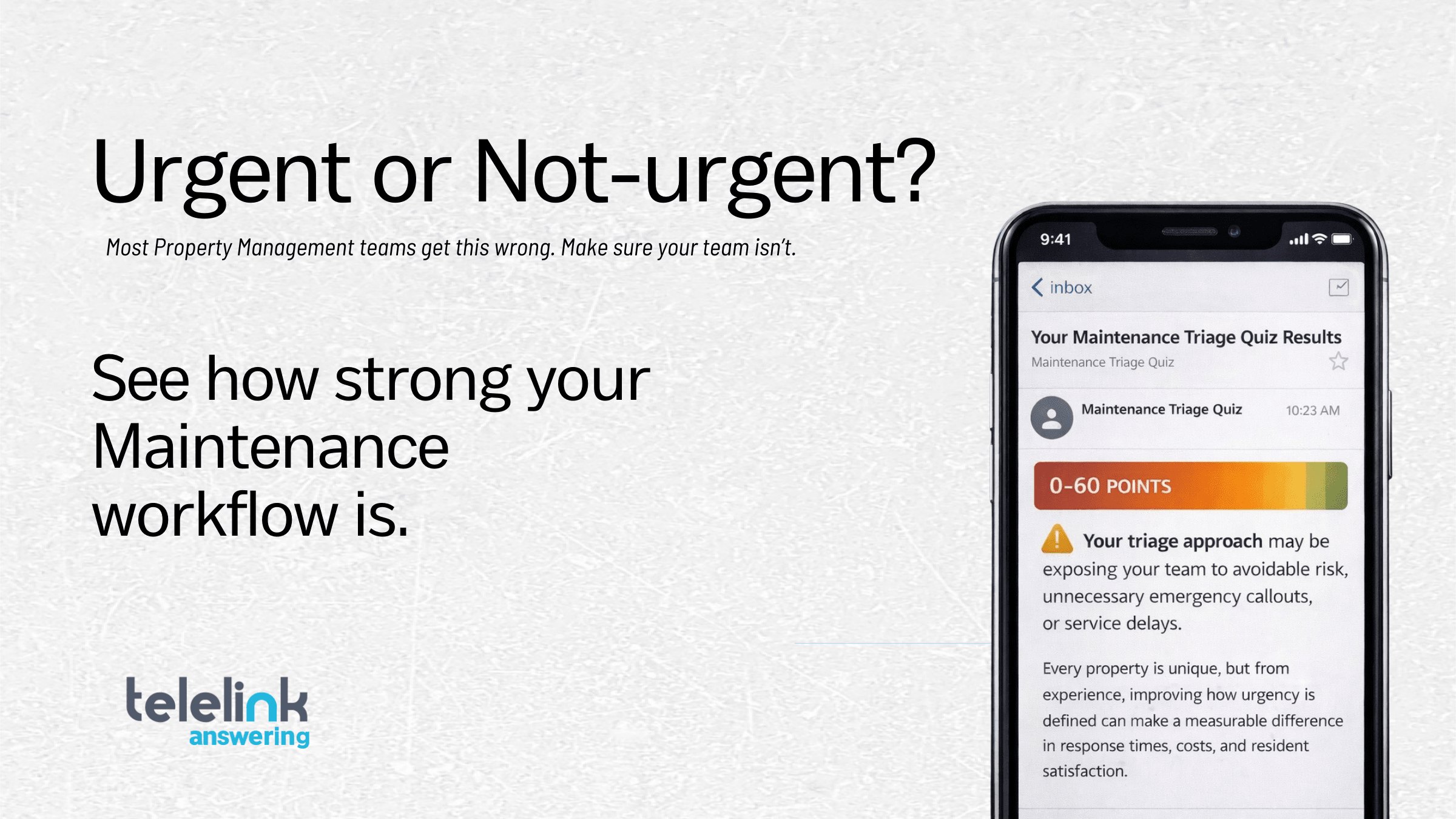
We turned those insights into a short maintenance triage assessment built around common scenarios. It is a simple way to see how your current workflow might be affecting cost, workload, and overall performance. Take the quiz to find out.
About Telelink
Telelink is Canada’s leading answering service provider for property management companies that value strong resident relationships. Our specialized property management division helps teams keep tenants satisfied while reducing operational pressure.
Our scripting process is built on industry best practices. Each script is designed to triage urgent and non-urgent calls while capturing the information your team needs, minimizing unnecessary follow-ups and interruptions.
The result is less stress for staff and a smoother experience for tenants.
Want to see how housing providers are streamlining maintenance and improving tenant satisfaction? Check out one of our Property Management case studies or download our Maximizing Maintenance Workflows guide.
Inside the guide, you’ll find real examples, a simple triage checklist, and practical strategies to reduce after-hours stress, protect your assets, and keep tenants happy while controlling costs.
Please note: Telelink is not a property management company. Telelink is a 24/7 call centre that specializes in servicing the property management industry. The opinions expressed in this article reflect our experience working with hundreds of property management and affordable housing organizations across Canada, conversations with industry subject matter experts, and our own informed perspectives built over 60 years in the industry. This content is not intended as regulatory or compliance guidance.